
Introduction
Relationships are one of the greatest gifts God has given us. They bring joy, support, encouragement, and connection. At the same time, they can also become one of the greatest sources of pain. If we are honest, every relationship will face moments of tension. Misunderstandings happen, words are spoken that cannot be taken back, expectations go unmet, and trust can be challenged. Over time, what once felt strong can begin to feel strained.
The question is not whether conflict will arise, because it will. The real question is how we will respond when it does.
The Reality of Relational Tension
One of the biggest misconceptions people have is believing that healthy relationships are conflict-free. That is simply not true. Conflict is not a sign that something is broken beyond repair. In many cases, it is a sign that something needs attention. Research in relationship psychology confirms that conflict is a normal part of human interaction. What determines the health of a relationship is not the absence of conflict, but how conflict is handled.
When conflict is ignored or mishandled, it creates distance. When it is handled properly, it can actually lead to growth and deeper connection. That is why Scripture does not instruct us to avoid conflict, but instead teaches us how to navigate it.
God’s Standard for Our Relationships
In Colossians 3:12–14, we are given a clear picture of how to respond when relationships become strained. Paul writes that we are to put on tender mercies, kindness, humility, meekness, and longsuffering, bearing with one another and forgiving one another, even as Christ forgave us. Above all, we are told to put on love, which is the bond of perfection.
What stands out in this passage is the phrase “put on.” That means these qualities are intentional. They are not automatic. They are choices we make, especially in difficult moments. When conflict arises, most people respond emotionally, but God calls us to respond spiritually.
You Cannot Avoid Conflict, But You Can Control Your Response
You may not be able to control what others say or do, but you can control how you respond. And your response has the power to either escalate the situation or move it toward healing. Too often, relationships are damaged not because of the issue itself, but because of how people respond to the issue.
Anger escalates conflict, pride causes defensiveness, and silence can create distance. But Christlike responses bring healing. Patience slows things down, humility opens the door for understanding, and kindness softens even the hardest moments. One right response can change the direction of an entire relationship.
Forgiveness Is Essential for Restoration
Forgiveness is one of the most important and challenging parts of restoring strained relationships. Many people hold onto hurt for years, replaying what happened and carrying emotional weight that was never meant to last that long. But unforgiveness does not protect you, it imprisons you.
Scripture calls us to forgive as Christ forgave us. That means forgiveness is not based on whether someone deserves it, but on our obedience to God. Forgiveness does not mean what happened was right, and it does not mean there are no consequences. It means you are choosing not to hold onto bitterness. It is the decision to release the burden so that healing can begin. When you forgive, you are not just releasing the other person, you are freeing your own heart.
Healing Requires Intention
Healing in relationships does not happen by accident. It requires action. Ignoring problems will not fix them, and avoiding conversations will not resolve them. At some point, someone has to take a step toward restoration.
That step may be a conversation, an apology, or simply a willingness to listen. Sometimes God will call you to take that step, not because you were wrong, but because you are willing. That is what maturity looks like. Healing begins when someone chooses to do what is right, even when it is difficult.
Love Holds Everything Together
At the center of it all is love. Scripture tells us that love is the bond that holds everything together. Love is not just a feeling, it is a commitment. It is choosing grace when emotions say withdraw, choosing patience when frustration rises, and choosing forgiveness when the hurt is real.
Love is what keeps relationships from falling apart when everything else is being tested. This kind of love does not come from us alone. It flows from our relationship with Christ. The more we grow in Him, the more we reflect Him in how we treat others.
Empowered Life Applications
• Recognize that conflict is a normal part of relationships and respond with wisdom instead of frustration
• Choose Christlike responses instead of emotional reactions, allowing patience, humility, and kindness to guide your actions
• Practice forgiveness as an act of obedience and healing, releasing bitterness and choosing freedom
• Take intentional steps toward reconciliation where possible, even if you have to be the one to initiate healing
Conclusion
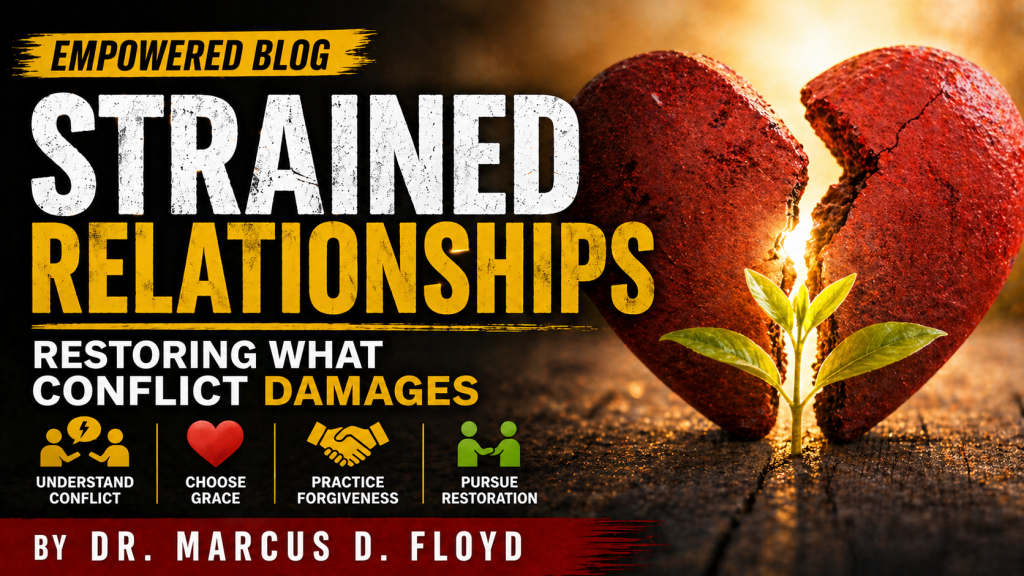
Strained relationships are difficult, but they are not hopeless. God has already given us the pathway to restoration. When conflict arises, respond with grace. When hurt occurs, choose forgiveness. When relationships are strained, pursue healing.
Grace and forgiveness restore what conflict damages. And when you do it God’s way, you will not just repair relationships, you will grow stronger through them.
In Christ Alone,
Dr. Marcus D. Floyd, D.Min.
Send Me Dr. Floyd's Devotionals
Becoming a partner with Marcus D. Floyd Ministries is more than sharing resources; it is about uniting in purpose and vision. Our partners are integral to bringing light to places of darkness. In return, you will receive regular updates on our ministry projects, exclusive access to edifying resources, and the indescribable joy of knowing that you are making a tangible impact.
This Week's TV Broadcast
Strained Relationships | Help for Hard Times Series | Message 4
Relationships are one of life’s greatest blessings, but they can also be one of the greatest sources of pain. In this powerful message from the Help for Hard Times Series, Dr. Marcus D. Floyd teaches how God calls us to respond when relationships become strained.
Drawing from Colossians 3:12–14, this message reveals that conflict is not the problem, how we respond is. Through grace, patience, and forgiveness, God provides a pathway to healing, restoration, and unity.
If you have ever struggled with broken communication, unmet expectations, or unresolved hurt, this message will encourage and equip you to handle relationships in a Christ-centered way.
Scripture:
Colossians 3:12–14 NKJV
Message Focus:
Reflecting Christ in our relationships through grace, patience, and forgiveness
Big Idea:
Grace and forgiveness restore what conflict damages
In This Message, You Will Learn:
• Why conflict is unavoidable in relationships
• How Christlike character changes relational outcomes
• The power of forgiveness to restore unity
• Practical steps to move toward healing and reconciliation
This message will challenge you to move beyond emotional reactions and choose responses that reflect the heart of Christ.
Watch The Empowered Life with Dr. Marcus D. Floyd
This message aired on the Christian Television Network, reaching audiences nationwide in the United States and in the United Kingdom, including England, Scotland, Wales, and Northern Ireland.
Learn how to watch or set your DVR
Ways To Watch on TV
Become a Partner
The Empowered Life is made possible through the generosity of partners and friends of Marcus D. Floyd Ministries.
If this message has blessed you, consider becoming a partner as we continue to influence the world for Christ.
Become a partner today
Donate
Final Encouragement
No matter what you are facing today, remember this
Jesus conquered the grave
Jesus defeated death
And because He lives, you can walk in victory
